
An agentic website is a site built for AI agents on two sides: agents that read it and act on it for your buyers, and agents that help your team build and update it. People still design it and approve what goes live.
Both sides are already real. At Webflow Conf in September 2026, Webflow's CMO Dave Steer told the room that AI agents now have their own budget line and read our websites just like we do (CMSWire). I run a Webflow agency that builds with agents every week, and most of what I read about agentic websites covers only one half of that sentence. This article covers both, then gives you a checklist to see where your own site stands. If you'd rather hand the whole thing over, that's what our agentic Webflow websites service is for.
The agentic web in one minute
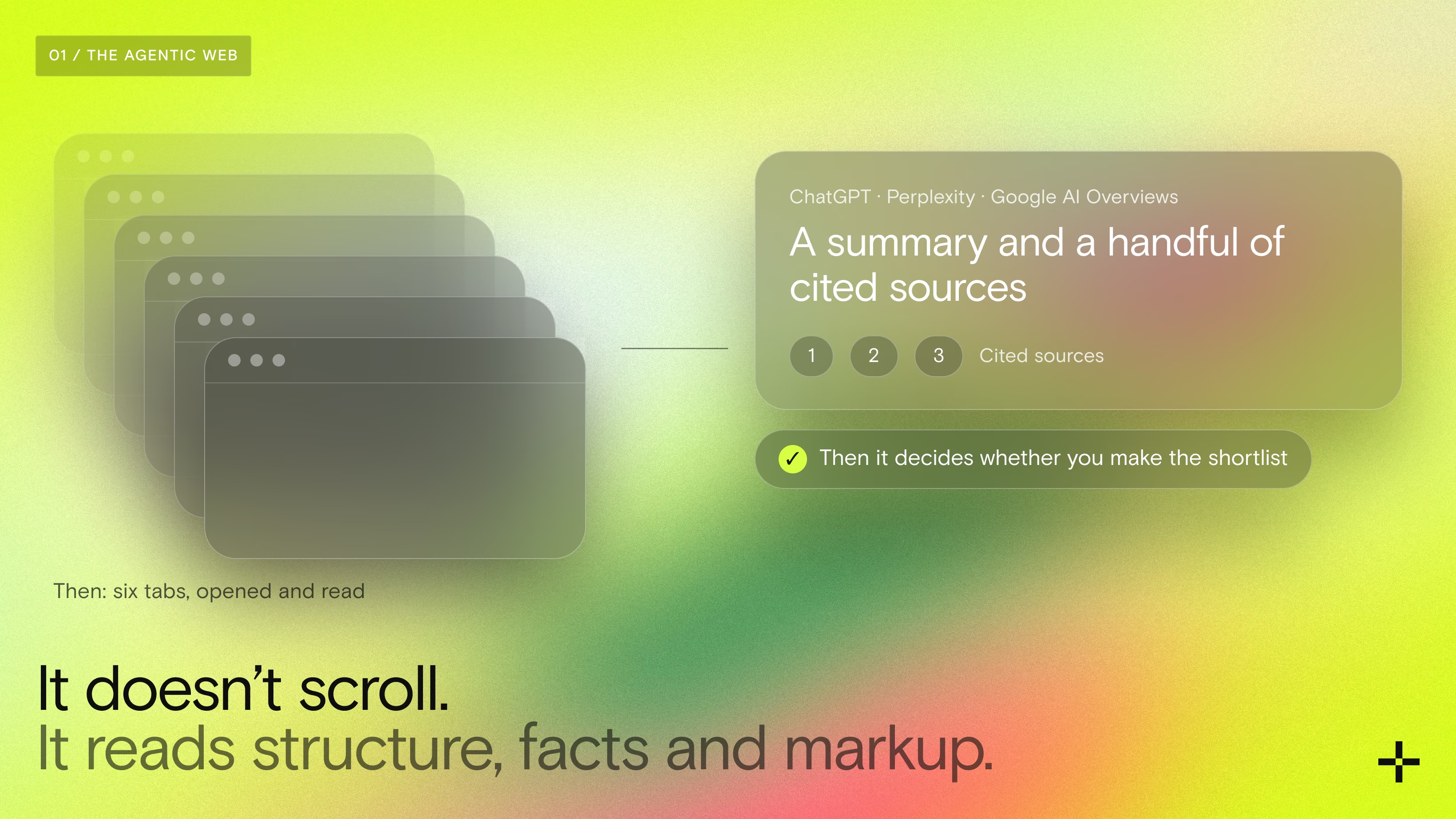
The agentic web is the shift from people clicking links to software agents finding, comparing and completing tasks for them. A few years ago a buyer typed a query, opened six tabs and read. Now a lot of that reading is delegated to an AI.
It shows up in two forms. Answer engines such as ChatGPT, Perplexity and Google's AI Overviews read pages and reply with a summary and a handful of cited sources. Browsing agents go one step further and act on the page. Perplexity's Comet browser, the agent in ChatGPT's desktop app and auto browse in Gemini in Chrome can click, fill in forms and compare options while the person does something else.
For your website, that means a second audience. It doesn't scroll, it doesn't admire the hero animation, and it won't read your tagline twice. It reads structure, facts and markup, and then it decides whether you make the shortlist.
Two meanings, one website
People use "agentic website" for two different things, which is why most explainers feel slippery.
- Readable by agents (outside in). Agents that belong to someone else visit your site to find and use what's on it: a buyer's assistant, an answer engine, a crawler.
- Operable by agents (inside out). Agents that belong to you work inside your site: drafting pages, updating the CMS and fixing metadata, under your rules.
Engineers and analysts mostly write about the first meaning. Website platforms and agencies have started selling the second. Most articles pick one and ignore the other.
I treat them as one definition because they depend on the same thing: a site whose content and structure are explicit enough for software to understand. Clean components, clearly named CMS fields and facts written as text make a site easier for an outside agent to read and easier for your own agent to edit. So here is the definition we work from: an agent-ready website is readable by agents and operable by agents.
Side one: readable by agents
A readable site lets an agent get the right answer about you without guessing. The work is unglamorous, and it pays off the day it ships.
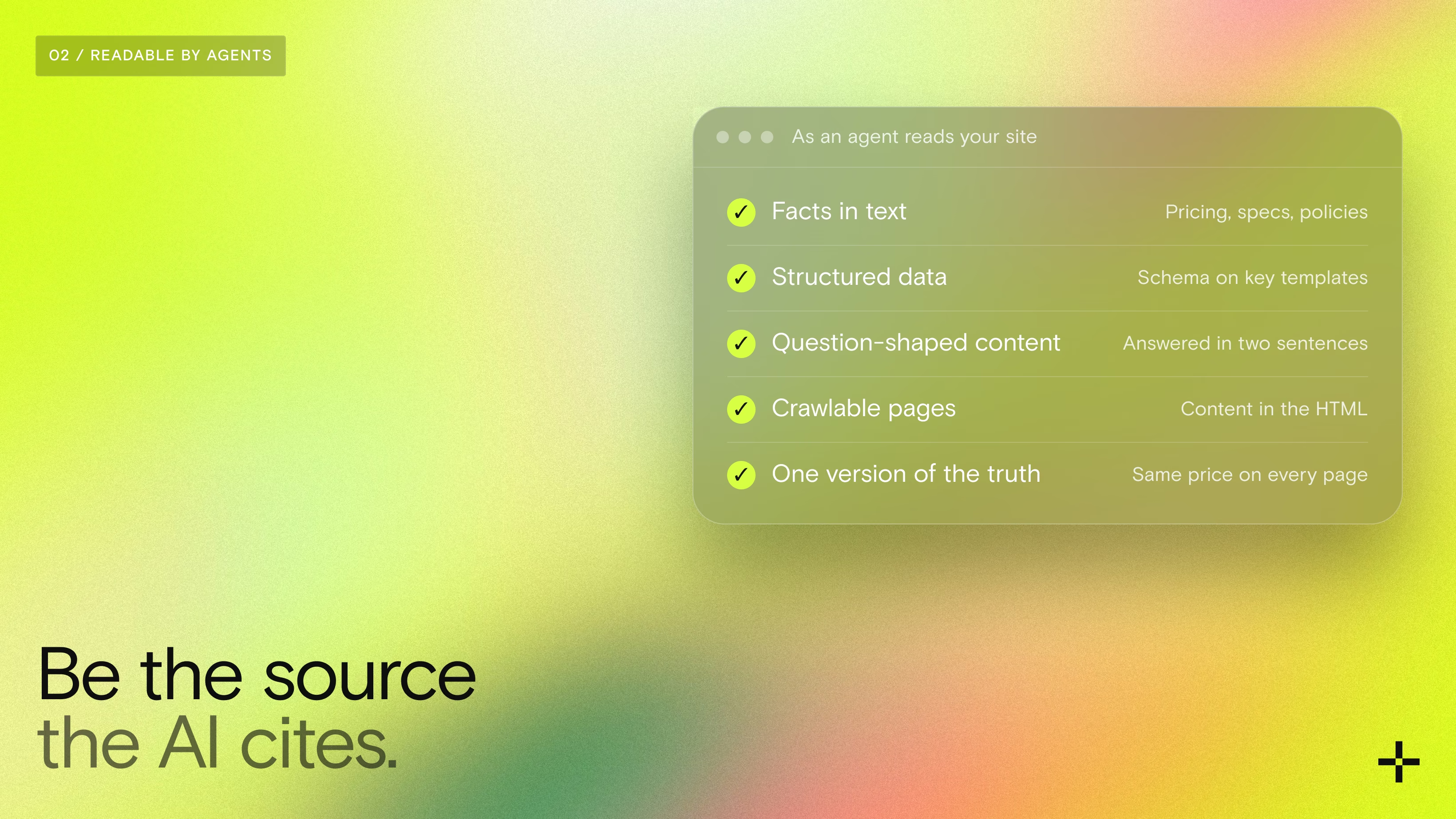
- Facts in text. Pricing, specs, integrations and policies are written on the page. An agent can't quote a number that only exists inside a screenshot or a PDF.
- Structured data. Key templates carry schema markup, so an agent knows which page is a product, which is an article and which block is a question with its answer.
- Question-shaped content. Headings ask what buyers ask, and the first two sentences under them answer it. Answer engines lift exactly that shape.
- Crawlable pages. The content is in the HTML and AI crawlers aren't blocked in robots.txt. Content that only appears after scripts run is invisible to most of them: a Vercel study found that the crawlers behind ChatGPT, Claude and Perplexity don't execute JavaScript, while Google's does.
- One version of the truth. The price on the pricing page matches the price in the FAQ and in the comparison post from two years ago. Agents read all three.
This is the work behind the labels agentic SEO, AEO and GEO. The labels keep changing and the job stays the same: be the source the AI cites. It's what we do in our Webflow SEO and AEO work.

Two standards get more attention than they have earned so far. The first is llms.txt, a Markdown file at the root of your domain that lists your most important pages for language models. Ahrefs studied 137,210 sites in 2026 and found that 28% publish one, and that 97% of those files received zero requests in a month (Ahrefs). Google also says you don't need one to appear in AI search. Publish it anyway, because it takes an hour, and don't expect it to move your citations. The second is NLWeb, an open project from Microsoft that lets a site answer natural-language questions and act as an MCP server for agents (Microsoft). It's worth watching, and it's too early to plan a site around it.
Side two: operable by agents
An operable site lets your own agents do production work without breaking the brand or the live site. A year ago, "AI on the website" meant pasting generated copy into the CMS. Now the agent connects to the site itself.
On Webflow, that connection is Webflow MCP. Version 2.0 shipped on July 21, 2026, at no additional cost for all users (Webflow). With it, an agent like Claude, ChatGPT or Cursor can:
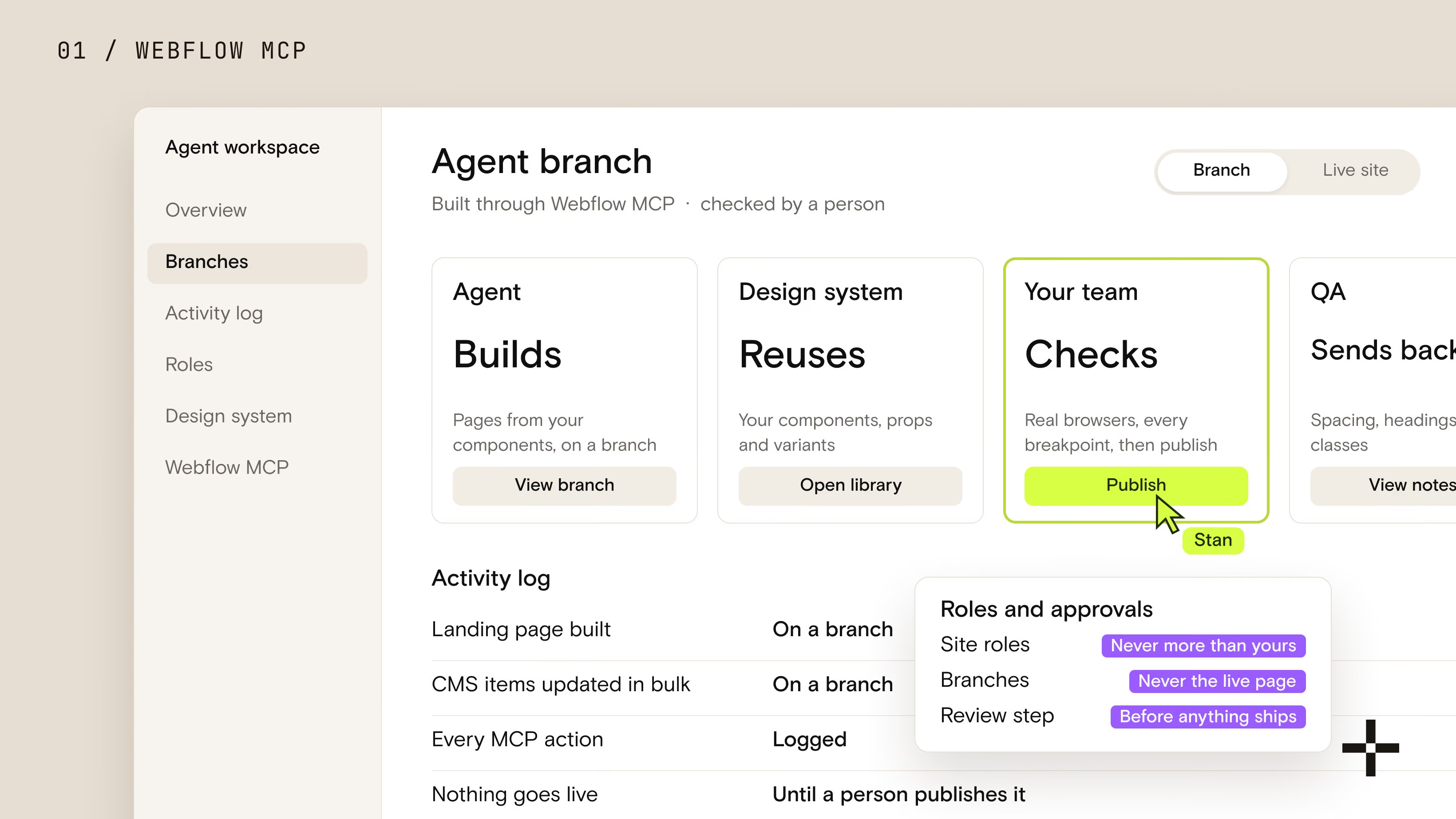
- build with your existing design system, including components, props, slots and variants
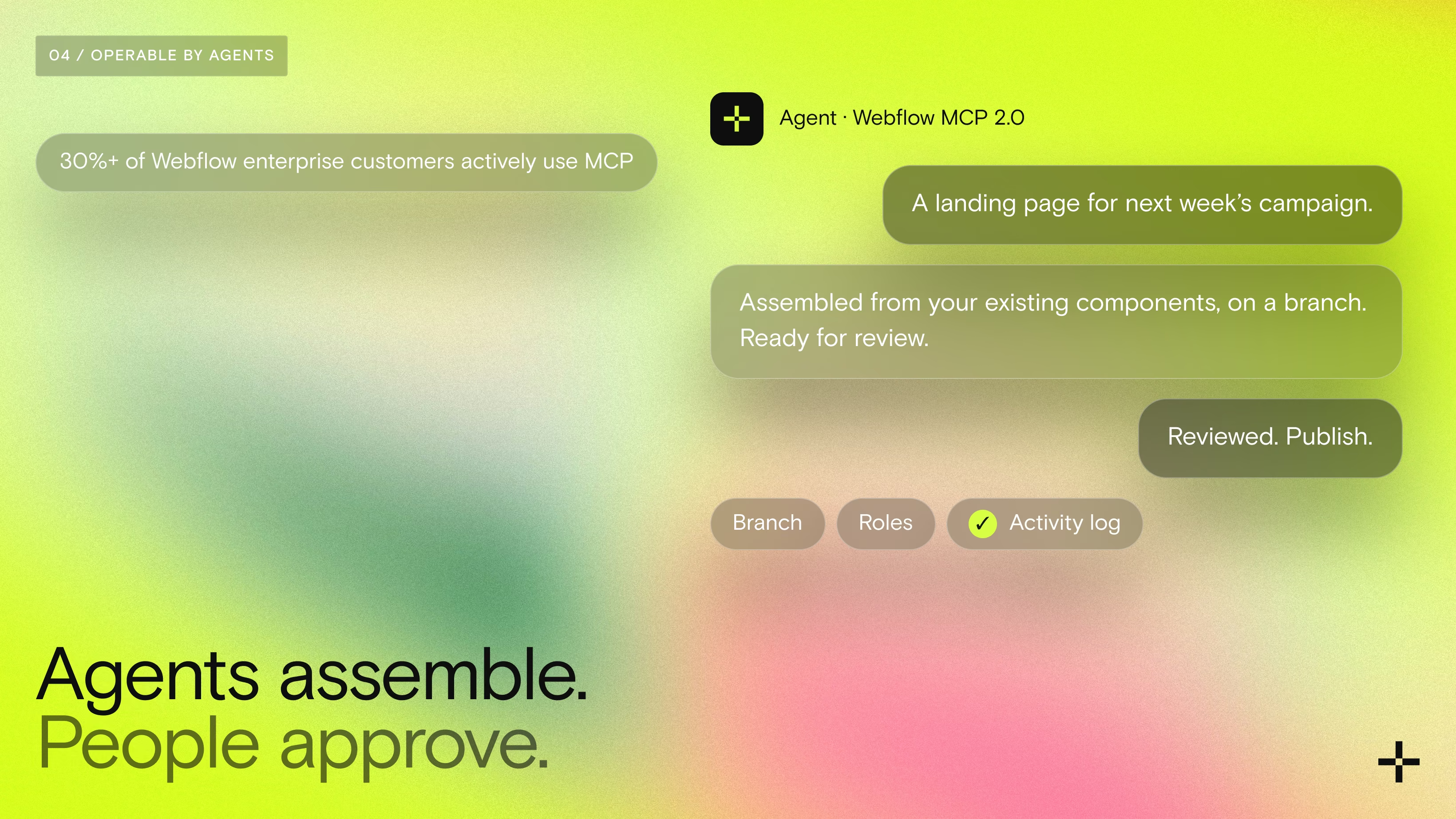
- work in a branch, away from the live site, until someone approves the result
- act only within the roles and permissions of the person who connected it
- leave every action in the site activity log
The rulebook for all of this is Agent Instructions: written rules and skills, kept in Webflow, that an agent reads before it touches anything.
The operable side has moved past the experiment stage. When MCP 2.0 launched, Webflow reported that more than 30% of its enterprise customers actively use MCP, and that usage had grown more than four times since January 2026 (CMSWire).
In practice it looks like this. A marketer asks for a landing page for next week's campaign. The agent assembles it from existing components on a branch. A person reviews it, fixes what needs taste, and publishes. Bulk jobs that used to eat an afternoon, like rewriting meta titles or adding alt text across a collection, become a prompt and a review.
There is one condition. The design system and the CMS have to be built for it. Give an agent a messy site and you get the same mess, faster. We learned that on our own site before we let an agent near a client's.
What an agentic website is not
Three misconceptions come up in almost every first call.
- A chatbot on the homepage. A chat widget is a feature. It changes nothing about whether outside agents can read your site or your own agents can run it.
- A site with no humans. People set the direction, own the design system and approve what ships. An agent with no reviewer publishes its mistakes at machine speed.
- AI-generated design. The agent builds from a design system. Someone with taste has to make that system first, and decide what good looks like.
Traditional vs agentic website
| Area | Traditional website | Agentic website |
|---|---|---|
| Who it's built for | Human visitors | Human visitors, and the AI agents acting for them |
| How pages get made | A designer and a developer build each page by hand | Agents assemble pages from the design system, people review and approve |
| How content is structured | Written for the layout, with facts often inside images and PDFs | Written as explicit facts in text, with schema and clearly named CMS fields |
| How it's found | Rankings in a list of links | Rankings, citations in AI answers and visits from agents |
| Governance | Whoever has the login | Roles, branches, activity logs and written agent rules |
| How you measure success | Sessions, rankings and form fills | All of those, plus AI citations, AI referral traffic and time from brief to live page |
How to tell if your website is agent-ready
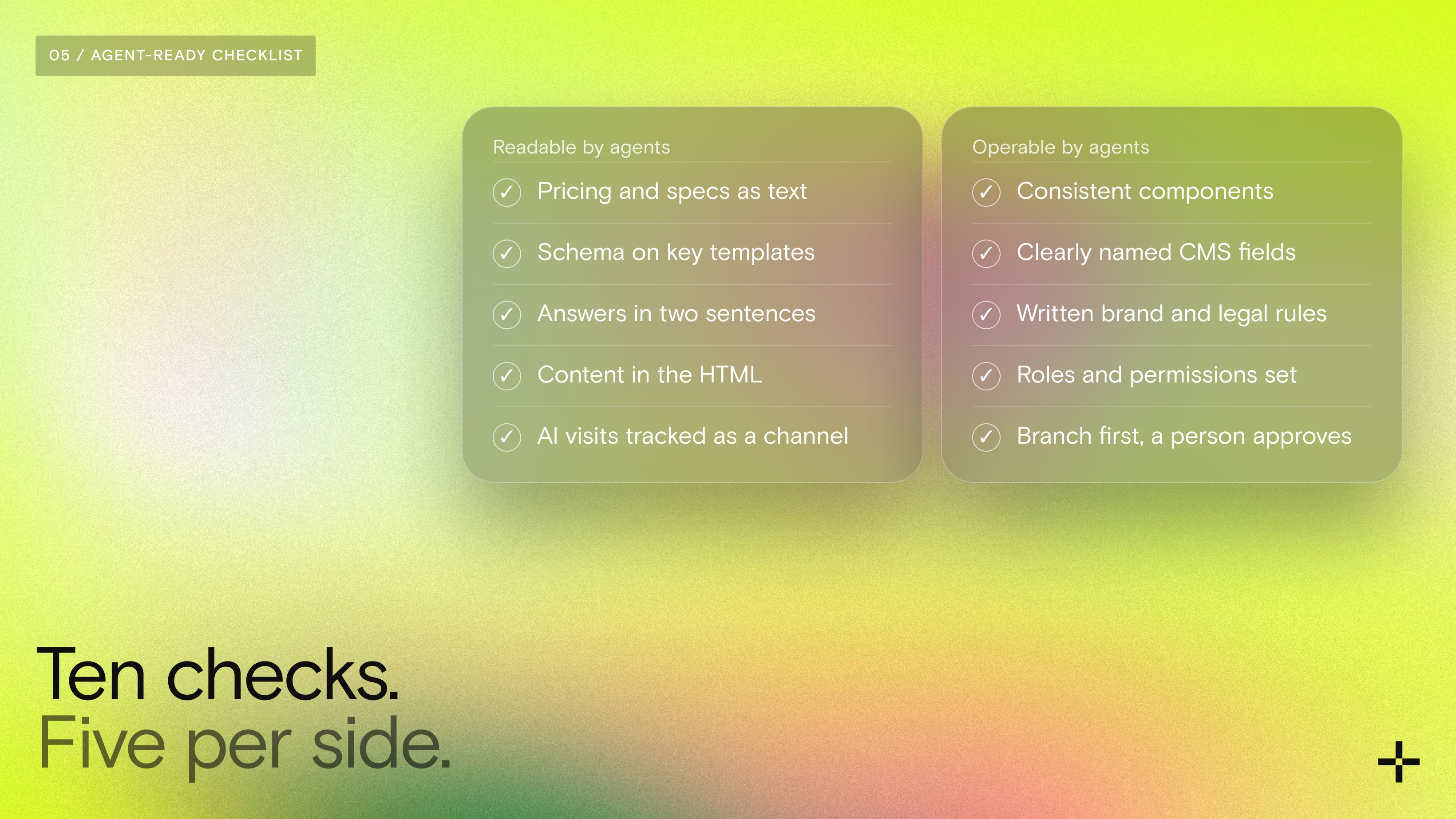
Ten checks, five per side. Answer them honestly and you'll know where to start.
Readable by agents
- Pricing, specs and policies are written as text on the page.
- Key templates carry schema markup: organization, article, FAQ, product or service.
- Your main pages answer their headline question in the first two sentences.
- The content is in the HTML, and AI crawlers aren't blocked in robots.txt.
- Visits from ChatGPT, Perplexity, Gemini and Copilot are a tracked channel in your analytics.
Operable by agents
- Pages are built from consistent components, with no one-off layouts.
- CMS fields are clearly named, and each one is used for a single purpose.
- Brand, voice and legal rules are written down where an agent can read them.
- Roles and permissions are set, so an agent can only do what its person can.
- Agent changes happen on a branch or on staging, and a person approves before anything publishes.
If you ticked fewer than five, start with structure: components, CMS fields and facts in text. Everything else on the list builds on those three.

How to get there
There are three paths, and they suit different starting points.
- Fix what you have. If your design system and CMS are in decent shape, an audit and a fix list will get you most of the way. This is the fastest path and the one most teams should try first.
- Rebuild on an agent-ready platform. If the site is a pile of one-off pages, patching it costs more than rebuilding it properly. Our view is that Webflow is the most practical agent-ready platform for marketing teams today, because the agent layer is native and governed: MCP, Agent Instructions, branches, roles and logs come from Webflow itself, with nothing bolted on.
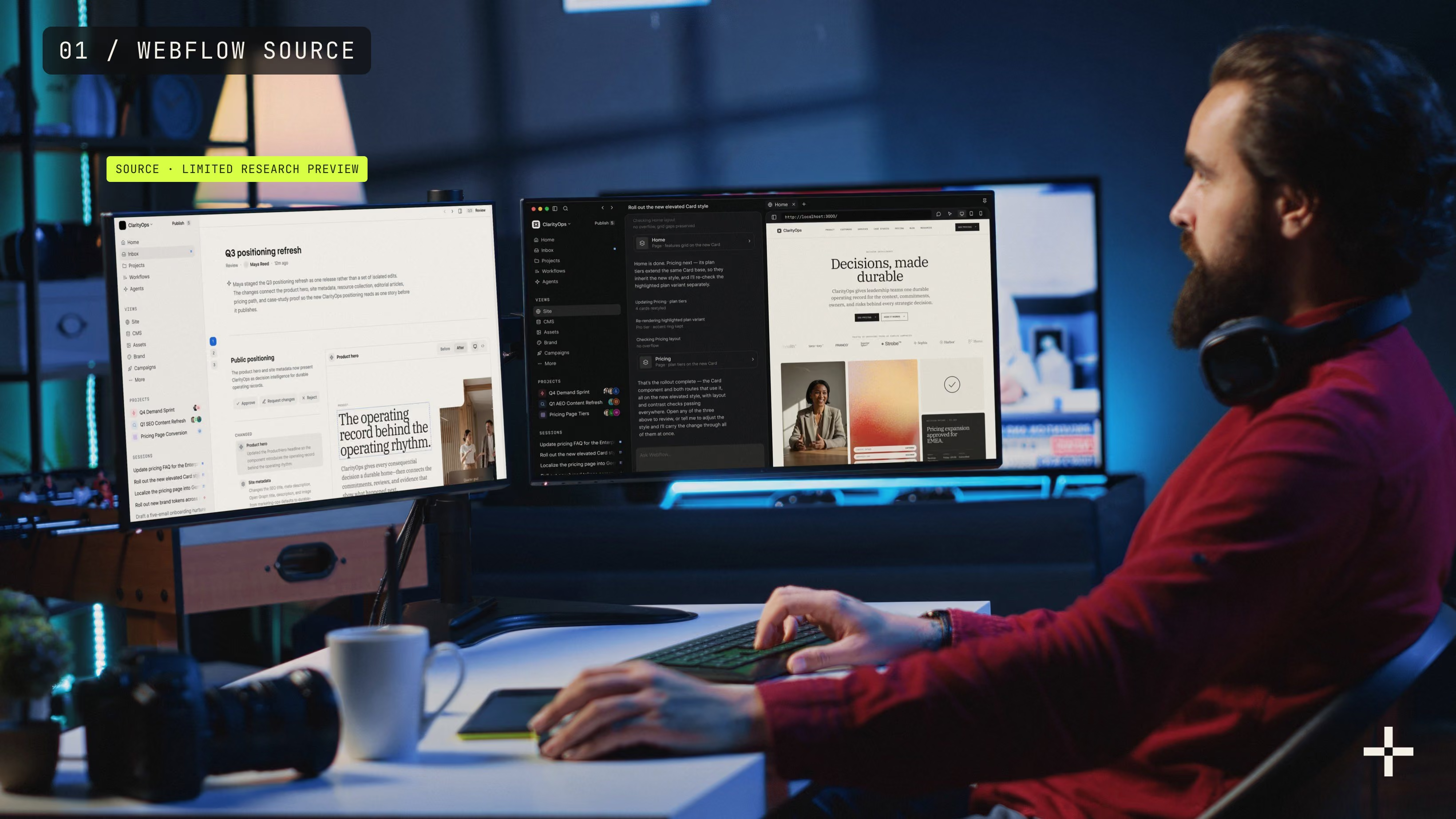
- Wait. Webflow has announced Source, a new platform for marketing teams and their agents, and it is in a limited research preview. We cover it in Webflow Source explained.
Waiting is the only path I'd argue against. The readable side starts working as soon as it's live, and the groundwork for the operable side is the same groundwork Source will ask for.
If you want to know where your site stands, our agentic Webflow websites service starts with an agent-readiness audit. We review your CMS structure, design system, schema and permissions, then hand you a fix list.
Let's find out if your site is agent-ready
One call. We look at your current site and tell you what an agent-ready version needs, with a real scope.
Let's talk