
What problem does Webflow solve for SaaS teams?
Most SaaS teams don’t switch to Webflow because it’s “easier.”
They switch because the old way is too slow.

Before Webflow, we’d join projects where updating one landing page headline required:
- a developer ticket
- a sprint wait
- a release cycle
- and two weeks lost for something that should take 10 minutes
During growth stages, that delay is deadly. Campaigns launch late, testing is slow, and conversion improvements arrive months after the insight. By the time the change ships, the opportunity is gone.
Webflow removes that bottleneck. Marketing can publish instantly, design teams iterate without engineering, and experiments move daily instead of quarterly.
Why fast-growing SaaS companies choose Webflow over WordPress
SaaS lives and dies by speed — speed of testing, speed of positioning, speed of learning. If your website can’t move at the same pace as your product, you’re already falling behind. That’s where Webflow becomes a weapon.
Each additional second of load time decreases conversion rates by an average of 4.42% (in the first five seconds)
Source: BrowserStack
It lets SaaS teams:
- Test and launch messaging fast — run experiments in hours instead of waiting for sprint cycles
- Build conversion-focused landing pages without developers
- Tell product stories with real motion and interaction, not flat screens
- Make SEO part of the growth engine, not an afterthought
- Scale CMS content structures for blogs, docs, changelogs, and resources
- Empower marketing to own the website instead of begging engineering
We’ve seen SaaS teams improve signup-to-demo conversions simply by being able to iterate messaging every day instead of once per quarter. And that speed compounds — every experiment becomes a lesson that informs the next.
Bad website velocity kills momentum. Webflow fixes that.
How Webflow improves conversion rates & A/B testing velocity

Most SaaS teams don’t lose deals because the product is weak.
They lose because they can’t test fast enough to learn what actually converts.
Conversion isn’t magic — it’s iteration. And iteration dies when every website change needs developers, sprints, QA cycles, and internal politics. That’s where Webflow becomes a real competitive advantage.
Webflow lets SaaS teams:
- Ship 10–20 variations of landing pages and messaging instead of 1 or 2 per quarter
- Run A/B tests in hours, not after 3 planning meetings
- Launch campaign pages instantly instead of waiting 2–3 weeks for backlog clearance
- Test pricing, positioning, and onboarding narratives without touching code
- Pair analytics + experimentation + storytelling in one place
We’ve seen conversion lift happen not because a design changed — but because teams were finally able to try more things, faster, and learn what resonates. Momentum compounds.
When the website moves fast, growth moves fast.
When the website is slow, everything else becomes slow.
What Webflow enables for SaaS growth teams (without the fluff)

Webflow isn’t about avoiding code.
It’s about removing bottlenecks.
Here’s what it actually enables for SaaS teams:
- Marketing moves without engineering — ship landing pages, run experiments, publish content daily instead of waiting through sprint cycles.
- Faster iteration — A/B test pages in hours, not weeks.
- Real control — no plugin dependency, no patching conflicts, no “ask the developer” for every change.
- Enterprise-level performance — global CDN, security, and speed handled out of the box, not duct-taped together.
- Animations that communicate value, not decorate — product storytelling becomes real, not a static brochure site.
- Scalability for content-heavy SaaS — a CMS that marketing can actually use without breaking anything.
We’ve seen teams go from releasing updates once a month to multiple times per day — without adding headcount.
Who Webflow is NOT for (limitations & honest cases Webflow fails)

Webflow isn’t the right choice for everyone. And pretending it is would be bullshit.
If your product needs:
- complex backend architecture tightly coupled to the frontend,
- a fully custom app with real-time dashboards and authentication,
- or a marketplace with multi-vendor logic — then Webflow won’t take you far on its own. You’ll need a custom build, or a hybrid setup using Webflow only for marketing pages.
Same story with eCommerce.
If you’re running a store with hundreds of SKUs, advanced inventory, multi-currency logic, or subscription billing, you’ll outgrow Webflow fast. Use Shopify or a custom solution and connect Webflow where it makes sense.
And if you need a $10/month drag-and-drop builder with zero learning curve, Webflow isn’t that either. It’s powerful but it demands real design thinking — and that’s exactly why SaaS teams love it.
Webflow shines when you want speed, control, and scalability for marketing, not when you’re trying to replace a full engineering stack.
Real Webflow case studies: Primer, Supy & Tolstoy
Primer
- Problem: every website change took 2+ weeks — even a headline update required developer tickets, sprint cycles, and negotiation. Marketing was blocked and couldn’t run experiments or launch campaigns on time.
- What changed: after migrating to Webflow, marketing took full control. We now ship landing pages and campaign pages in days, and small updates happen almost instantly.
- Result: publishing time went from ~2 weeks → real-time, developer dependency dropped close to zero, and the marketing team finally moves at growth speed. A Slack message replaces what used to be a sprint request.
- Micro-story: the feedback from their team was immediate — marketing described it as “finally being unblocked” after months of frustration.
Supy
- Problem: their previous agency ran the site in WordPress with outdated thinking, slow delivery, and old-school design. The website felt outdated and didn’t match the ambition or product quality. Conversion elements were missing entirely.
- What changed: we redesigned the entire experience in 6 weeks, built it in another 6, migrated 200+ blog articles while preserving SEO performance, added conversion-focused flows, and delivered the site in three languages with significantly improved Core Web Vitals.
- Result: the new site reflects a modern product instead of an old-fashioned enterprise tool. Page performance improved, SEO integrity was preserved, and conversion flows are now built directly into the experience.
- Micro-story: launched 2 days ago — no metrics yet, but the team’s reaction said everything.
Tolstoy
- Problem: they were about to launch their new AI Suite, but their website didn’t communicate the story, value, or positioning. They needed a complete redesign fast — and the clock was ticking.
- What changed: we built a fully new site from the ground up, expanded their structure beyond the previous one, repositioned them as an AI-driven platform, and launched an entirely new brand experience in under 1 month.
- Result: SEO rankings improved significantly, editing content is easy, and the team can publish changes instantly without dev involvement.
- Micro-story: the urgency was real — product ready, website not. Four weeks later, everything went live on time.
Webflow vs WordPress: Speed, publishing & performance comparison
Most WordPress vs Webflow comparisons talk about plugins, templates, or pricing. None of that actually matters when you’re a SaaS team moving fast.
Here’s the real difference:
With WordPress, every change becomes a ticket.
With Webflow, every change becomes a button click.
In WordPress, marketing waits for developers.
In Webflow, marketing publishes without asking.
WordPress works until the moment you need speed. Then it becomes a bottleneck — plugins conflict, updates break layouts, deployment requires QA, and pages load slower than the ideas behind them. We’ve seen this play out repeatedly.
Primer wasn’t on WordPress — they were on a custom setup where every change required developer involvement. Same outcome: two-week turnaround for tiny updates. Moving to Webflow removed that dependency and let the team publish instantly.
Supy migrated 200+ blog posts from WordPress because maintaining performance and multilingual structure became painful. The difference in page speed and control was immediate.
Tolstoy launched an entire AI repositioning in under a month — something that would have taken months in WordPress with agency dependencies and plugin chaos.
So the question isn’t:
“Which platform has more features?”
The real question is:
“Which platform removes friction and helps you move faster?”
For high-growth SaaS, that answer is Webflow. The contrast becomes obvious when you compare how both platforms handle real work:
Webflow vs WordPress vs Framer: Which is best for SaaS?
Most comparison articles talk about plugins, templates, or pricing. None of that matters when you’re trying to ship experiments fast. The real difference is velocity.
Different platforms solve different problems. For SaaS velocity, experimentation speed matters more than feature lists. Here’s what happens when you compare platforms through a growth lens instead of a feature checklist:
Most teams switch to Webflow not because it’s “easier,” but because it removes the bottlenecks that slow growth. If speed of publishing, experimentation, and learning matter — Webflow is the only platform built for that reality.
WordPress powers over 43% of all websites on the internet, but plugin dependency is the primary cause of performance loss, as excessive or poorly coded plugins add load time, increase HTTP requests, and cause bloat.
Source: Optiweb
Is Webflow good for SEO?

Yes — if SEO matters to you, Webflow is one of the strongest platforms available. It outputs clean HTML/CSS without plugin bloat, ships with fast global hosting, and gives full control of metadata, structured data, redirects, OpenGraph, and performance optimizations.
Google officially lists speed and Core Web Vitals as ranking factors — which is why lightweight, clean code platforms like Webflow often outperform plugin-heavy setups.
Source Google Search Central
We’ve migrated sites from WordPress where Core Web Vitals improved immediately simply because Webflow removes the plugin dependency that slows most WP setups. Speed is a ranking factor — and speed is Webflow’s default state.
Where SEO wins in Webflow:
- Clean code output (no page builder junk DOM)
- Built-in performance optimization & global CDN
- Easy control of semantic structure & metadata
- No plugin updates breaking pages
- Structured CMS that scales with content strategy
SEO isn’t a checkbox — it’s infrastructure. Webflow gives you control instead of chaos.
How much does a Webflow website cost in 2026? (Real ranges)
It depends on complexity — but transparency helps.
HubSpot’s own data shows that marketers who use A/B testing and optimization tools see a 107% increase in leads within six months and a 134% increase in website traffic.
Source: 6minded
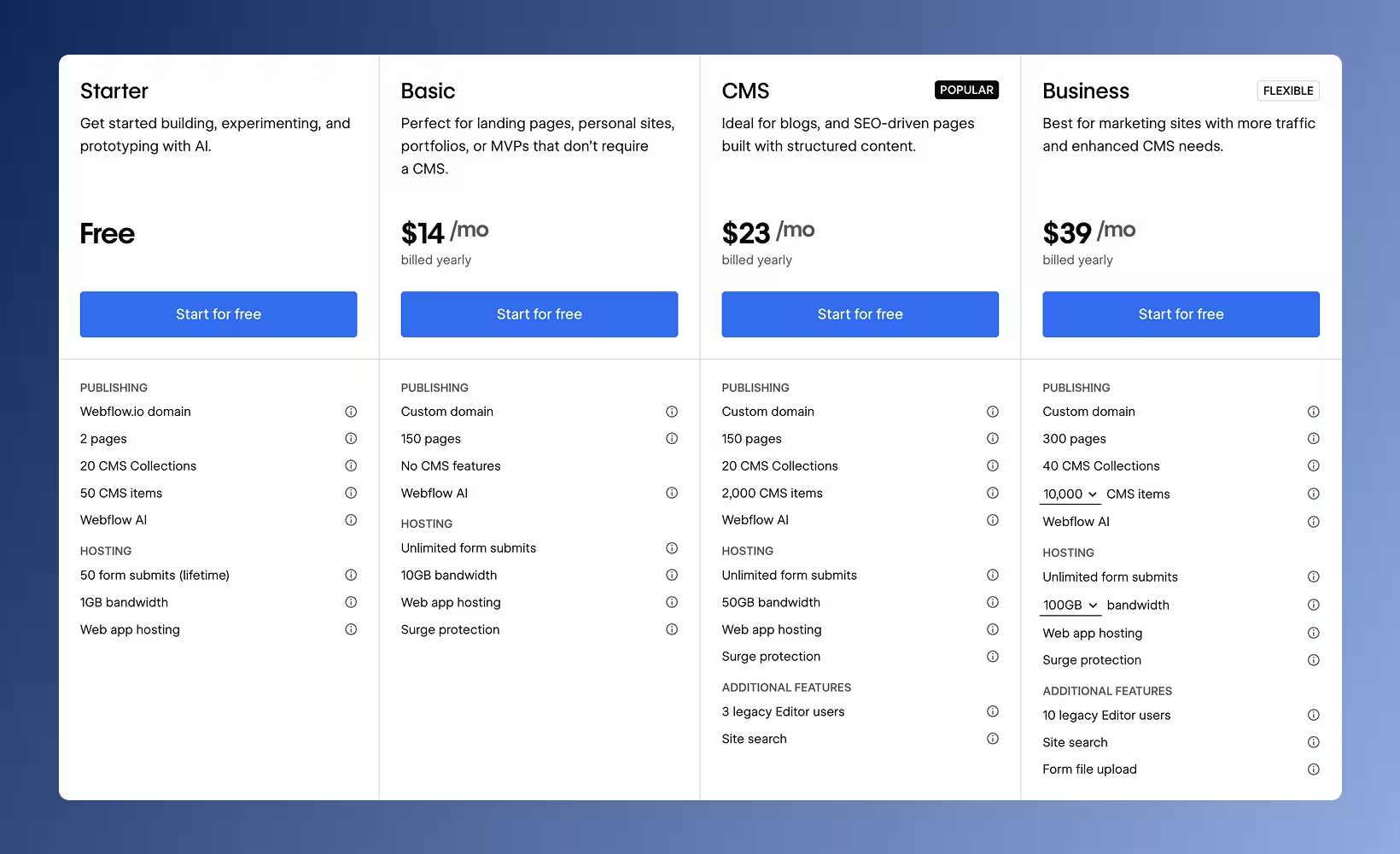
Platform costs
- Free for building/prototyping
- $14–39/mo for hosted marketing sites
- Enterprise pricing based on security & traffic
Build cost
A real SaaS website built for growth (not templates) typically sits around:
- $25K–$40K for strategy, design, Webflow development (depends on scale)
- $5K–$8K/mo ongoing growth + testing cycles for high-velocity teams
Cheap templates are not Webflow.
Good Webflow is an advantage engine.
Is Webflow good for enterprise teams? (Security, SSO, scalability)
Yes — with the Enterprise tier, teams get:
- SOC2 compliance & SSO/SAML
- Global scaling & advanced security
- API access & advanced collaboration workflows
- Custom traffic capacity
Enterprise teams choose Webflow not for simplicity — but for control and speed at scale.
We’ve worked with enterprise SaaS companies where delivering a new landing page took one Slack message instead of a sprint cycle. That’s budget impact, not just convenience.
Webflow powers enterprise teams including Deloitte, Dell, Nasdaq, and Dropbox. Their security stack includes SOC2, SSO, SAML, and advanced global scaling.
When to choose Webflow vs when to avoid it

Strong use cases
- SaaS marketing sites & conversion funnels
- SEO-driven content engines (blogs, docs, changelogs)
- High-velocity experimentation & A/B testing
- Launching new products, features, and positioning fast
Wrong use cases
- Custom dashboards or authenticated apps
- Complex multi-vendor marketplaces
- Heavy-duty eCommerce with 1000s of SKUs
- Real-time financial/trading front ends
- Use Webflow where it accelerates growth, not where it becomes glue.
Common misconceptions about Webflow
There’s a lot of confusion around Webflow — mostly from people who haven’t actually built anything serious with it. A few myths come up constantly:
“Webflow is just for small websites.”
Not even close. We’ve built complex multilingual, CMS-heavy, animation-rich SaaS sites with hundreds of dynamic pages. If anything, Webflow shines most when structure and scale matter.
“Webflow can’t handle enterprise.”
It can — and it does. We’ve worked with teams running enterprise infrastructure, strict security requirements, and global content workflows. Webflow’s enterprise tier exists for a reason.
“It’s just a drag-and-drop builder like Wix.”
If that’s what someone says, they’ve never opened Webflow Designer. It’s closer to building in code visually, not dragging blocks into a grid.
“You’ll hit limitations fast.”
Only if the project is poorly planned. Most limitations are actually architecture problems, not platform limits. 90% of “Webflow limitations” are solved with a proper CMS structure, component system, and dev-level thinking.
“Developers hate Webflow.”
Developers love Webflow when it removes repetitive work. They get to focus on real product shipping instead of pushing pixels and fixing broken WordPress plugins.
“It’s too expensive.”
Try calculating the cost of waiting two weeks for a landing page update. Speed makes money. Bottlenecks cost it.
Webflow pros & cons summary
Webflow isn’t perfect. No platform is.
Here’s the honest version — based on real work, not marketing slides.
Where Webflow is exceptional
- Speed of publishing & iteration — marketing moves without waiting on engineering
- Design freedom — real storytelling, motion, and micro-interactions that clarify complex SaaS products
- Performance — fast by default, great Core Web Vitals, global CDN
- CMS flexibility — perfect for content-heavy SaaS teams (blogs, docs, resources, changelogs)
- Scalability without plugins — cleaner long-term maintenance and fewer breakages
- Lower dependency cost — fewer developers needed for surface-level changes
Where Webflow struggles
- Complex backend logic — it’s not a replacement for a full application framework
- Heavy eCommerce — not ideal for big SKU catalogs or multi-currency operations
- Requires real design thinking — not for drag-and-drop template users
- Advanced multilingual setups need planning — powerful, but must be architected well upfront
Who gets the most value from Webflow
- Fast-moving SaaS teams
- VC-backed startups in growth mode
- Founders who treat speed as a competitive advantage
- Marketing teams blocked by slow website pipelines
Who shouldn’t use Webflow
- Low-budget DIY builders
- Marketplace or platform apps that need deep real-time backend logic
Final thoughts — Why Webflow is a competitive advantage
Webflow isn’t winning because it’s “no-code.”
It’s winning because it gives SaaS teams something far more valuable — speed.
When every change requires a developer, growth stalls.
When marketing can ship pages and tests instantly, growth accelerates. We’ve seen it firsthand with teams like Primer, Supy, and Tolstoy: going from two-week delays to same-day launches, migrating 200+ articles without losing SEO, and rebuilding entire product stories in under a month.
Webflow is not the right tool for everything.
It’s not a replacement for complex backend systems or large eCommerce catalogs. But if your website is your growth engine — not a static brochure — Webflow becomes a competitive advantage.
If your site feels slower than your ambition, it might be time to rethink the platform beneath it.
Frequently asked questions
Is Webflow better than WordPress for SaaS?
For fast-moving SaaS teams — absolutely. WordPress works until the moment speed matters. If every change requires plugins, QA, and dev tickets, you’re already losing momentum. Webflow wins because marketing can publish instantly and build without engineering dependency.
Will Webflow hurt SEO?
No. In most migrations we’ve done, SEO actually improves because Webflow outputs clean HTML/CSS, removes plugin bloat, improves Core Web Vitals, and gives full control of metadata and structured data. SEO isn’t a plugin — it’s infrastructure, and Webflow gets that right.
Does Webflow improve Core Web Vitals?
Yes. We’ve seen teams jump from red to green scores simply by removing bloated page builders and plugin stacks. Performance is built in: global CDN, optimized assets, and lightweight DOM. That directly impacts rankings and conversions.
How fast can SaaS teams publish on Webflow?
Realistically? Minutes. Teams ship landing pages, tests, and copy updates the same day instead of waiting weeks for deployment cycles. That speed compounds into conversion lift — more tests = more learning.
Can Webflow scale for content-heavy SaaS products?
Yes, when structured right. We’ve migrated 200+ article blogs, multilingual content, docs, changelogs, and resource hubs into Webflow CMS without losing SEO authority. Architecture matters — not plugins.
Is Webflow good for enterprise?
Yes. SOC2, SSO/SAML, Enterprise security, advanced workflows, and real collaboration. Enterprise teams choose Webflow for control and speed, not because it’s “no-code.”
When does Webflow not make sense?
If you’re building complex backend apps, real-time dashboards, heavy eCommerce catalogs, or multi-vendor marketplaces. Use Webflow where it accelerates marketing, not where you need full application logic.
If your website feels slower than your growth, let’s talk
If you’re stuck waiting weeks for changes that should take minutes, or you feel like your site isn’t keeping up with your product momentum — we’ve seen it, and we’ve helped fix it. Sometimes a one-hour conversation is enough to spot what’s blocking speed and conversion.
No sales pitch. No agency jargon. Just a real look at where you’re losing time — and what’s possible with the right setup.