
Commerce tech teams that trust us








Selling software to online stores is its own job
Your buyer runs a store. They judge you on revenue lift, installs and whether you work with their stack, and they decide fast.
Most commerce tech sites lead with features and a wall of merchant logos. Buyers want the lift each merchant got.
Every integration needs a page
Each app you connect to deserves its own page, and nobody has time to build them one by one.
Two buyers, one homepage
Brand marketers want revenue proof; ecommerce ops want to know it works with their stack. A generic homepage loses both.
Logos without numbers
Merchant logos fill the page, but buyers want to see the lift each merchant got.
The app store listing outsells your site
Your listing has reviews and installs; your site has a headline. Buyers go back to the listing to decide.
Commerce tech sites we designed and built
Six companies that sell to online stores, from SMS marketing to AI support agents. The numbers are what changed after launch.
39%
more users publish in their first session
54%
growth in daily active users after the redesign
44%
higher CTR after the messaging rework
83%
more product sign-ups after launch
44%
longer time on site
4
months from blank slate to brand and live site
$4.7M
seed announced the month the new site launched
37%
more sessions in the two months after launch
27%
longer average session time after the relaunch
What we build for commerce tech teams
Three kinds of commerce software work with us. Pick yours.
Marketing and growth tools
- Paths for brand and growth buyers: each with the revenue proof that buyer asks for.
- Customer stories with the metric up front: one CMS template your team fills in for every merchant.
- Sign-up flows that match the app store: install-first calls to action and pricing a merchant reads at a glance.
- Proof: GoAudience got 62% more sign-ups; SMSBump grew 850% in a single year, to 28,000 active stores.
AI support and sales agents
- Pages that show the agent working: real conversations and resolved tickets instead of chat-bubble illustrations.
- Integration pages: the store platform and helpdesk stack, each from one CMS template.
- Trust for a new category: security, data handling and how the agent hands a conversation to a person.
- Proof: Zipchat got 83% more product sign-ups; Siena announced its $4.7M seed the month the new site launched.
Commerce services and operations
- Service pages that read like a product: what you manage, for which brands, and the result.
- Proof by merchant size: case studies sorted from growing brands to enterprise retailers.
- A CMS your team runs: new services, case studies and hires without a developer.
- Proof: Capline, ecommerce managed services for $10M to $1B+ brands, rated 5.0 on Clutch.
Integration and partner pages your team publishes in minutes
Commerce tech lives inside a stack. We build integration, partner and customer story pages as CMS templates, so a new partner gets its page the day the deal is signed.
- Integration pages: one template for every app you connect to, with setup steps and screenshots.
- Customer stories: the merchant, the metric and the quote, in a layout buyers can scan.
- Comparison pages: you against the tool a merchant uses today, kept current from the CMS.
- Launch pages: new features and app store releases out the same day, without a developer.
What we design for commerce tech companies
The work commerce software companies buy from us, from positioning to the pages that keep up with every launch.
Website design and build
Homepage, product and pricing pages in Webflow, for a buyer who runs a store and decides fast.
Move to Webflow
Off WordPress or Framer, with a redirect map and no lost rankings.
Ongoing Webflow work
New pages, integrations and launch pages after go-live, at $80 per hour on a retainer or an hour pack.
Brand and positioning
A clear position in a crowded app category, and an identity that holds up next to the brands you serve.
Conversion
Sign-up and demo flows designed around the merchant's decision, then tested page by page.
What a commerce tech website costs
Marketing sites start at the project price. Enterprise builds with SSO, localization and 500+ pages start from $40,000.
A commerce tech specialist, a generalist agency, a freelancer, or an in-house hire
The honest version of this table. Here is where each option lands for a team selling software to online stores.
| StanVision | Generalist agency | Freelancer | In-house team | |
|---|---|---|---|---|
| Ecommerce and app store experience | Deep, across 6 commerce tech case studies | Occasional | Varies by person | Deep on your product, lighter on category patterns |
| Integration and partner pages as CMS templates | Built in | Often hand-built | Rarely | Depends on the team |
| Brand, product and site in one team | Yes | Sometimes | No, you coordinate vendors | Yes, once fully hired |
| Launch in 10 to 12 weeks | Yes | Variable | Bottlenecked on one person | Slowed by hiring |
| Stays after launch | Yes, 3+ year average | Project-based | Moves on | Yes |
Industries we go deep in
We specialize where design and growth decisions carry the most weight.
Commerce tech website questions we get asked
Straight answers to what commerce software teams ask before they start, cost first.
How much does a commerce tech website cost?
Projects start from $15,000 and take 10 to 12 weeks with brand included. Enterprise builds start from $40,000. Ongoing work after launch is $80 per hour, on a monthly retainer or a prepaid hour pack.
Do you build Shopify stores too?
Yes, for brands. See eCommerce & Shopify. This page is for the software companies that sell to them.
Can we publish integration and partner pages without a developer?
Yes. Integration, partner, customer story and comparison pages run on CMS templates your team fills in, so a new page goes live in minutes.
Is Webflow better than WordPress for a marketing site?
For most B2B marketing teams, yes, because Webflow hands editing to marketing instead of engineering. You get a visual CMS, fast hosting, and clean code without a stack of plugins to patch and secure. WordPress can still make sense when you need a specific plugin ecosystem or very heavy custom backend logic, which is the honest exception.
What are the downsides of Webflow?
Webflow has real limits worth knowing before you commit. Pricing scales with traffic and CMS size, very complex custom app logic can outgrow it, and large content migrations need planning to avoid SEO loss. For a marketing site that the team needs to own and update, those trade-offs are usually easy to accept, and migration risk is what we plan for first.
How do you optimize a B2B marketing site for AI search?
You structure the site so answer engines can quote it. That means self-contained answers to the questions buyers actually ask, clean semantic markup and schema, and pages that state facts plainly instead of burying them. It is the same work that earns featured snippets, extended to ChatGPT, Perplexity, and AI Overviews, and it pairs with our SEO and AEO service.

Website redesign checklist: everything to plan before design starts

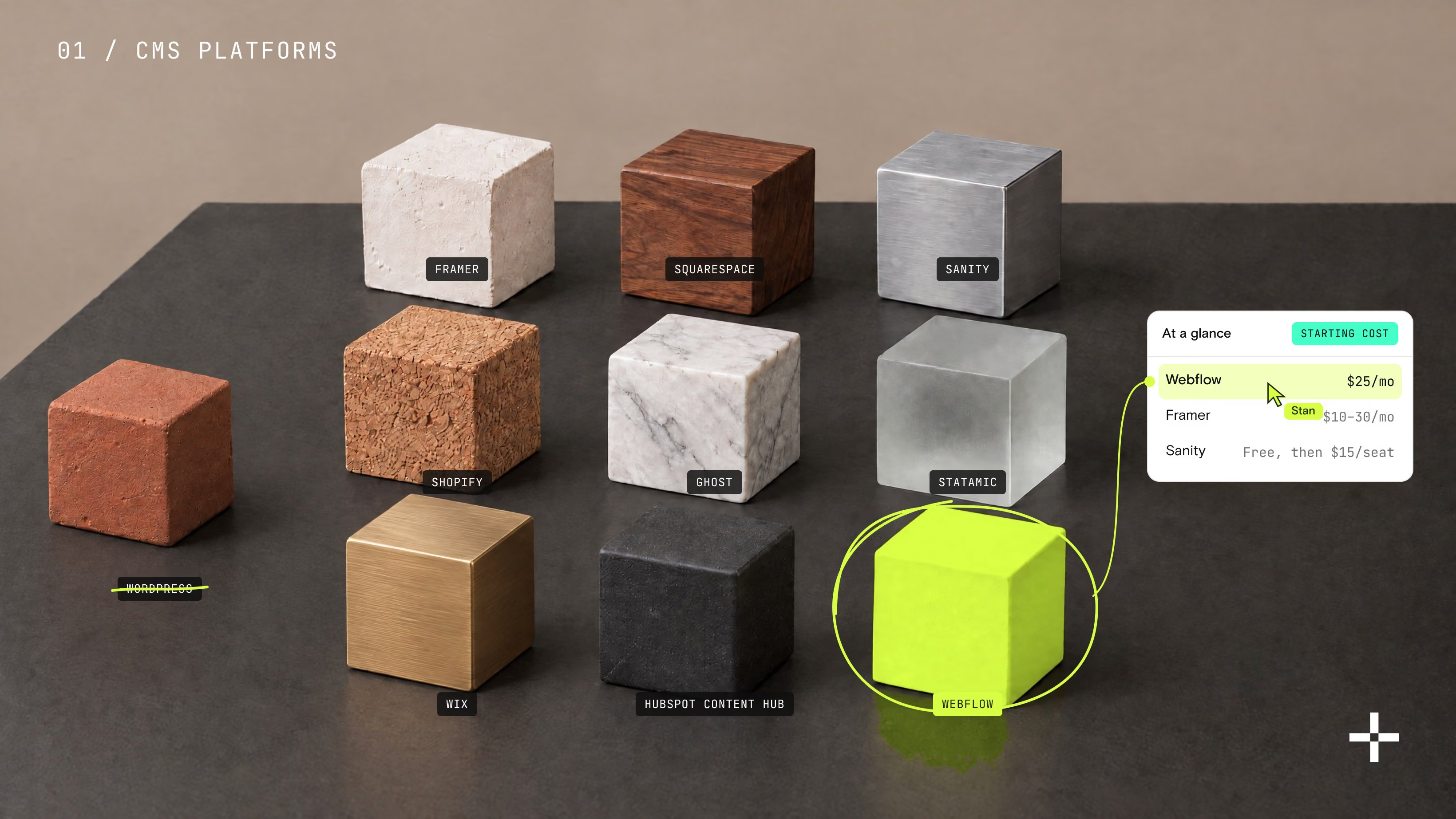
Looking beyond WordPress? 9 CMS platforms worth considering in 2026

Is Webflow good for SEO and AEO? The honest 2026 answer

Best SaaS website design examples in 2026 (and what actually makes them convert)